
Eyebrow thinning can happen for many reasons, from normal aging and over-plucking to medical conditions that affect hair follicles. As interest in red light therapy and photobiomodulation (PBM) grows, one question is appearing more often: can red light therapy help eyebrow growth?
The short answer is that the research is promising but still early. Red and near-infrared light have been studied for hair-related applications, and a small human study has specifically examined LED photobiomodulation for eyebrow loss. However, that does not mean every red-light device is proven to regrow eyebrows, and it does not establish an eyebrow-growth indication for an eye-area skincare device.
What is red light therapy and photobiomodulation?
Photobiomodulation is the use of specific wavelengths of light to interact with biological tissue. Red and near-infrared wavelengths are commonly studied because they can penetrate tissue to different depths and are used in a growing range of skincare, wellness and hair-research applications.
In hair research, scientists are studying whether light-based stimulation may influence processes associated with follicle activity and the hair-growth cycle. The exact effects depend on factors such as wavelength, energy delivered, treatment schedule, device design and the reason for hair loss.
Can red light therapy help eyebrows? What the research says
There is some direct human evidence worth paying attention to. A published study evaluated LED therapy in 16 women with eyebrow loss caused by frontal fibrosing alopecia. Participants received a course of LED photobiomodulation treatments, and researchers reported a significant increase in total eyebrow hair count after the treatment series.
That result is encouraging, but it needs to be interpreted carefully. The study was small, involved a specific medical form of eyebrow loss, and did not test the Numiere Feather LED Eye Mask. It therefore cannot prove that red light therapy will grow eyebrows in everyone or that any particular consumer device will increase eyebrow density.
You can review the study on PubMed.
Why wavelengths matter
Not every LED color is used for the same purpose. Hair-related photobiomodulation research is generally centered on red and near-infrared light, rather than blue or yellow light. But wavelength alone is not enough to establish that a device is effective for hair growth. Irradiance, treatment time, total energy, placement and clinical validation all matter.
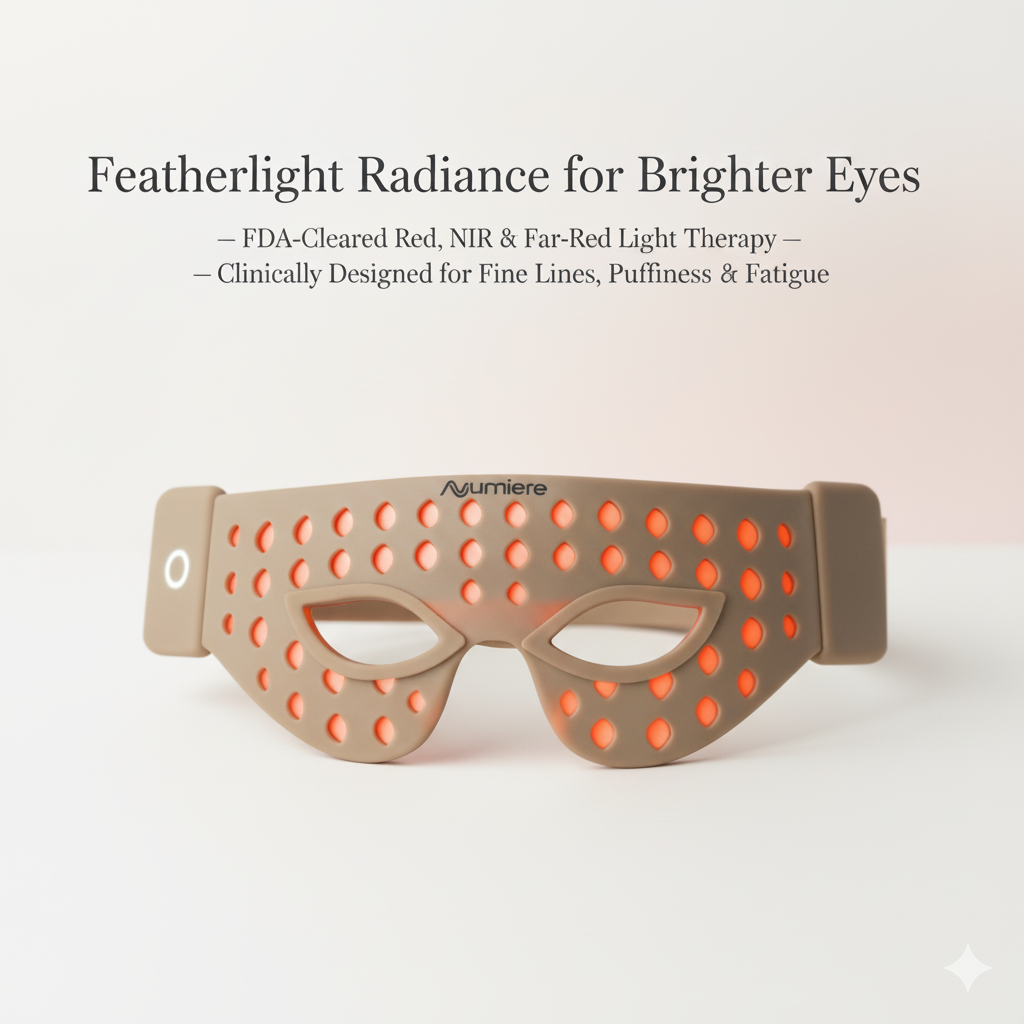
The Numiere Feather LED Eye Mask uses three wavelengths listed in its FDA 510(k) summary:
- 630 ±10 nm red light
- 660 ±10 nm deep-red light
- 850 ±10 nm near-infrared light
Those wavelengths overlap with red and near-infrared regions studied in photobiomodulation research. That overlap is scientifically interesting, but it is not the same as proving eyebrow-growth efficacy.
Where the Feather LED Eye Mask fits
Feather is designed to sit around the eye and brow area, making it relevant to shoppers who are researching red light therapy around the eyebrows. Its established regulatory indication, however, is important to understand clearly.
Feather is FDA-cleared for the treatment of facial wrinkles. It is not FDA-cleared to grow eyebrows or treat hair loss. The FDA 510(k) record for Feather is K251871, and its summary describes the red, deep-red and near-infrared wavelengths used by the device.
You can review the public FDA 510(k) record for K251871 and the FDA 510(k) summary.
The FDA summary specifies a 3-minute treatment time for Feather. Do not increase session length or create a separate hair-growth schedule in an attempt to target the eyebrows. Use the device only according to its included instructions.
What should you look for in a red-light device used near the brows?
- Clear wavelength specifications: The manufacturer should identify which wavelengths the device actually emits.
- Designed for the eye area: Eyebrows sit close to the eyes, so device design, positioning and safety instructions matter.
- Truthful indications: Distinguish between what a product is FDA-cleared to do and what researchers are still investigating.
- A defined treatment protocol: More exposure is not automatically better. Follow the device's labeled treatment time and instructions.
- Real clinical evidence: A wavelength may be interesting scientifically, but product-specific studies are stronger evidence than broad claims about red light in general.
Does red light therapy increase blood flow or cellular energy around hair follicles?
Photobiomodulation research investigates several biological mechanisms that may be relevant to tissue and follicle activity. However, it is easy for general scientific mechanisms to become overstated in advertising. A mechanism being studied does not automatically mean a specific consumer device has been clinically proven to stimulate blood flow, increase cellular energy in eyebrow follicles or produce eyebrow regrowth.
For that reason, we think the most useful approach is to separate what the research is exploring from what Feather itself is cleared and proven to do.
Frequently asked questions
Does red light therapy grow eyebrows?
Early research suggests LED photobiomodulation may have potential for some forms of eyebrow hair loss, but the evidence is still limited. A small human study reported improved eyebrow hair counts in women with frontal fibrosing alopecia. More research is needed before broad conclusions can be made.
Which wavelengths are studied for hair-related photobiomodulation?
Research commonly focuses on red and near-infrared wavelengths. The exact wavelength is only one part of treatment; energy, irradiance, treatment duration and protocol also affect how light is delivered.
What wavelengths does Feather use?
According to its FDA 510(k) summary, Feather uses 630 ±10 nm red, 660 ±10 nm deep-red and 850 ±10 nm near-infrared light.
Is Feather FDA-cleared for eyebrow growth?
No. Feather is FDA-cleared for treating facial wrinkles. It is not FDA-cleared for eyebrow growth, hair regrowth or treatment of hair loss.
Can I use Feather longer to try to grow my eyebrows?
No. Do not extend the treatment time beyond the instructions. The FDA summary specifies a 3-minute Feather treatment. Follow the user guide supplied with the device.
Why discuss eyebrow research if Feather is not cleared for eyebrow growth?
Because many consumers are searching for information about red light therapy and the eyebrow area, and Feather's wavelengths overlap with wavelengths being investigated in photobiomodulation research. We believe it is more useful to explain the research accurately than to turn emerging science into an unsupported product claim.
The bottom line
Red light therapy for eyebrow growth is an interesting and emerging area of photobiomodulation research. A small human study has reported promising eyebrow-hair results, but the evidence is not yet strong enough to say that all red-light devices grow eyebrows.
For shoppers interested in targeted red and near-infrared light around the eye and brow area, explore the Numiere Feather LED Eye Mask. Feather combines 630 nm red, 660 nm deep-red and 850 nm near-infrared light in an eye-area device that is FDA-cleared for facial wrinkle treatment.
Research and regulatory references
- PubMed: Novel Application of Light-Emitting Diode Therapy in the Treatment of Eyebrow Loss in Frontal Fibrosing Alopecia
- FDA 510(k) K251871 — Feather
- FDA 510(k) Summary — K251871
Important: This article is for educational purposes and discusses emerging research into LED photobiomodulation. It does not establish an eyebrow-growth indication for Feather. Feather is FDA-cleared for treating facial wrinkles and is not FDA-cleared to grow eyebrows or treat hair loss. Individual results vary. Always follow the user guide and consult a qualified healthcare professional if you have unexplained eyebrow loss, a medical scalp or skin condition, photosensitivity, or questions about using a light-based device.